RSS

Frozen Pipes in Cochrane: How to Prevent Them and What to Do If One Freezes

Every winter in Cochrane there's a stretch of deep cold, and that's when pipes freeze. From my time as a home inspector, a burst pipe was one of the most expensive things I saw a family deal with in winter, and it was almost always a pipe that was easy to protect ahead of time.

Here's what I'd do now, before the cold settles in, and what to do if you're heading away over the holidays.

Know where your water shut-off is

If a pipe bursts, the first few minutes matter. Find your main water shut-off valve now. In most Cochrane homes it's in the basement, near where the water line comes through the foundation, often by the water meter. Make sure it turns, and show everyone in the house where it is. The Insurance Bureau of Canada lists this as one of its top winter tips, and I agree. It's the cheapest damage control there is.

Where pipes freeze

Pipes freeze where cold air reaches them. The usual spots:

  • Pipes on outside walls, especially under kitchen and bathroom sinks

  • Lines that run through a garage, crawl space or unheated porch

  • Outdoor taps

  • Anywhere there's a draft, like a rim joist in an unfinished basement that was never sealed

If you have an unfinished basement, take a flashlight and follow the water lines. Anything close to an outside wall or near a draft is worth a foam pipe sleeve. They cost a few dollars at the hardware store and slip right on.

Outdoor taps

Take the hoses off. A hose left on can trap water in the tap and split it, even on a frost-free tap. If your outdoor tap has a separate shut-off valve inside the house, close it, then open the outside tap to drain the line. Many newer homes have frost-free taps with no inside shut-off. Those are designed to drain on their own, as long as the hose is off.

On the coldest nights

  • Open the cabinet doors under sinks on outside walls so warm air can reach the pipes

  • Keep the heat steady day and night. A big setback overnight is when a marginal pipe gives up

  • Keep the garage door closed if any water lines run through it

  • If one tap is known to be trouble, run water through it from time to time

Heading away for the holidays

This is the one people miss. The Insurance Bureau of Canada says that if you go away during the heating season, even for a few days, you should leave the heat on and have someone you trust check on your home. It says failing to do so can affect your coverage. Most policies spell out how often the home has to be checked, so read yours or call your broker before you leave, not after.

A few other things before you go:

  • Leave the heat on. Don't drop it to save a few dollars

  • Have your house-sitter check the furnace is running and look under the sinks

  • Leave them your shut-off location and your plumber's number

  • If the home will be empty for a long time, talk to your insurer. IBC notes that most policies exclude frozen-pipe damage in a vacant home, and that shutting off the water and draining the lines is the safer move

If a pipe freezes

If you turn on a tap and get only a trickle, suspect a frozen pipe. Leave the tap open and warm the pipe slowly with a hair dryer or a space heater kept well away from anything that can burn. Never use an open flame. If you can't find the frozen spot or can't reach it, call a plumber. And if a pipe has already split, shut off the main valve first, then call your plumber and your insurer.

Who owns the water line in Cochrane

This one surprises people. In Cochrane, the Town is responsible for the water service from the main to the curb stop valve, and the property owner is responsible for the pipe from the curb stop valve to the house. If a leak or a freeze is on your side of the curb stop, the repair is yours, so it's worth checking that your home insurance covers water line leaks and breaks.

The Town lists a few signs of a leak on your service line: lower water pressure, a sump pump that runs a lot, the sound of running water in the basement with no visible source, and soft or wet ground that isn't from watering. If you suspect a leak, the Town will investigate for free. Call (403) 851-2500.

Why it matters if you're buying or selling

When I inspected homes, water stains under sinks, patched drywall on outside walls and new sections of pipe in an otherwise older system told me about past freezes. Buyers and their inspectors notice the same things. If you're selling in the spring, keeping the pipes safe this winter is one less thing to explain.

The short version

  • Find your water shut-off and show the family

  • Hoses off, and drain outdoor taps that have an inside shut-off

  • Sleeve pipes near outside walls and in the garage

  • Keep the heat steady, and open sink cabinets on the coldest nights

  • Going away? Read your policy and have someone check the house

  • From the curb stop to the house, the pipe is yours

If you're in Heritage Hills or anywhere else in Cochrane and you have a question about something you've noticed in your home, call or text us any time. Our neighbourhood guide is a good place to start if you're thinking about a move.

Wayne & Sean Burton, REMAX West Real Estate

Read

Mitford: The Forgotten Ghost Town Just West of Cochrane

If you've driven past Mitford School in West Valley, you've seen the name. But long before there was a school, a subdivision or much of a Cochrane at all, Mitford was a town of its own, with a sawmill, a hotel, a saloon and a little steam engine called Betsy. Within about a dozen years it was gone.

A different Cochrane

Our town is named after Senator Matthew Cochrane, whose Cochrane Ranche started up in 1881. Mitford's story belongs to a different Cochrane.

Tom Cochrane (T.B.H. Cochrane) was the son of Admiral Sir Thomas Cochrane of England. He and his wife, Lady Adela, daughter of the Earl of Stradbroke, came to Canada in 1883. They first took a large grazing lease near High River, then in 1885 traded it for one in the country west of today's Cochrane. There's no record that either lease was ever stocked with cattle. Instead, Tom decided to go into lumber.

The sawmill and the Betsy line

Early in 1886, Tom finished a sawmill on the north side of the Bow River, about three miles west of the present town, near where the CPR crosses the river. It went into operation that July and could turn out 30,000 board feet of lumber a day.

The trouble was the timber. The good stands were well to the north, so the Cochranes built a private railway up the Horse Creek valley, with wooden rails on the far end and horse-drawn cars hauling logs down to a turnaround. A small steam engine, known as Betsy, ran the rest of the way. The line was known as the Betsy line, and Betsy had an alarming habit of jumping the track. The grade out of Horse Creek was steep, and the engine sometimes ran away on the way back down with a load of logs.

Then came the cruel irony. The best fir in the area went into the ties and rails of the railway itself. By the time the line was built, there was little good fir left to saw.

Saw Mill becomes Mitford

The settlement was first known, plainly, as Saw Mill. Lady Adela wrote to the CPR's William Van Horne, a friend of hers: "Saw Mill is not a pretty name." In 1887 the townsite was renamed Mitford, in honour of Mrs. Percy Mitford, a friend of Lady Adela's who also had money in the Cochrane ventures.

The spot was beautiful but hard to live in. The town sat on a narrow bench where Horse Creek meets the Bow, squeezed between the river, a steep hill and the railway, with only a treacherous ford across the river.

A real town, for a while

Even so, Mitford grew. By 1888 there was a store, a hotel and a livery stable, plus bunkhouses for the sawmill and mine workers. Dr. Hayden arrived in 1888 and ran a small drug store alongside his practice. The post office opened in 1889. Tom Cochrane even built a toll bridge across the Bow: five cents to walk across, ten cents for a team and wagon.

In 1891, Lady Adela hired Isabel Monilaws of Bruce County, Ontario, to teach, and a school opened in the old saloon. It was the first school between Calgary and Morleyville. In 1892 an Anglican church went up on the hill northeast of town, paid for in part with money Lady Adela raised in England.

One venture after another

The sawmill closed in 1890. It had struggled from the start. A coal mine nearby used the sawmill's railway, but its coal was hard to dig and never really paid. The Cochranes' last try was a brickyard with three primitive kilns, using clay hauled in by Betsy from a flat about two miles north. The bricks were poor and expensive to make, and the brickyard lasted two summers before it was abandoned in 1893. Betsy was sold to a lumber mill near Golden, B.C., and the track was pulled up.

The railway didn't help. The CPR never liked stopping at Mitford. Eastbound trains had to back up half a mile to get a run at the grade out of town, and westbound trains stopped with the engine sitting on the bridge. Local kids discovered that a little grease on the track sent westbound trains sliding right through town before they could stop. In 1893, the CPR cancelled regular stops.

The end of Mitford

Over the next few years, people drifted away, some to the growing town of Cochrane, where a couple of Mitford's business owners set up shop. Tom Cochrane ran for the House of Commons in 1896 against Frank Oliver and lost, and the Cochranes soon went back to England. By 1898, Mitford was deserted, and fire had destroyed many of the buildings. The Anglican church was moved into Cochrane.

Today, all that's left at the old townsite is a small cemetery, on what is now private property, so it isn't open for a visit.

Mitford today

The name lives on. When Rocky View Schools renamed Mitford Middle School to Mitford School in 2013, residents and the school asked to keep "Mitford" because of its history in the area. Mitford School sits in West Valley, on the west side of town.

If local history is your thing, Mitford pairs well with our story about Glenbow, the ghost town near Cochrane that built the Alberta Legislature. And if you're thinking about a move in or around Cochrane, our neighbourhood guide is a good place to start.

Wayne & Sean Burton, REMAX West Real Estate

Read

Window Condensation in Winter: A Home Inspector’s Guide for Cochrane Homes

Every year, the first real cold snap brings the same question: "Why are my windows dripping?" From my time as a home inspector, wet or frosted windows were one of the most common things I saw once winter settled in. The good news is that in most homes, the fix costs next to nothing.

Why it happens

Warm indoor air holds moisture. When that air touches something cold, like a window pane on a -20°C morning, it cools down and can't hold as much water, so the extra moisture lands on the glass. The colder it gets outside, the colder the glass gets, and the less humidity your home can carry before you see water or frost.

That's why the same house can be perfectly dry in October and dripping in January. The windows didn't change. The weather did.

Step one: measure, don't guess

Pick up a hygrometer. It's a small, inexpensive humidity reader sold at most hardware stores, and it takes the guesswork out. Put one in the main living area and check it first thing in the morning, when condensation is usually at its worst.

CMHC's rule of thumb is to keep indoor relative humidity between 30 and 50 per cent during the heating season, and around 30 per cent once it's colder than -10°C outside. CMHC also notes that in very cold weather, 30 per cent or lower may be needed to keep windows clear, and that newer, energy-efficient windows can handle higher humidity without condensing.

The simple fixes

Start with the free stuff. Health Canada's guidance on moisture and mould lists most of these, and they match what I'd tell clients at the end of an inspection.

  • Use your fans. Run the bathroom exhaust fan during and after showers, and the range hood when you cook. If your fan doesn't seem to pull much air, hold a square of toilet paper up to the grille. If it doesn't stick, the fan or its duct needs a look.

  • Open the coverings. Heavy curtains and blinds trap cold, damp air against the glass. Open them during the day, and leave a gap at night on the worst windows.

  • Let the heat reach the glass. Keep furniture away from heat registers and baseboard heaters, and leave interior doors open so air can move.

  • Wipe the sills. On the bad mornings, dry the frames and sills. Standing water is what turns into peeling paint, swollen trim and mould.

  • Check your furnace humidifier. This is the big one I used to find. Many homes have a humidifier on the furnace with the dial set once and never touched again. Turn it down as the temperature drops, or off during a cold snap, and turn it back up when it warms.

  • Watch other moisture sources. Lots of plants, drying laundry indoors, an aquarium or a damp basement all add up.

If you have a heat recovery ventilator (HRV), make sure it's running and that its filters are clean. It's designed to swap stale, humid indoor air for fresh outdoor air without losing much heat.

When it's the window, not the humidity

If your humidity reads around 30 per cent on a cold morning and you still have water on the middle of the glass, the windows themselves may be at their limit. And if you see fog or moisture between the panes of a sealed unit, that's a failed seal. Wiping won't help, and lowering humidity won't fix it. The sealed unit needs replacing, though often not the whole frame.

Frost on the frame that keeps coming back can also point to air leaking in around the window. Fresh caulking or weatherstripping is a cheap fix that can help with both comfort and your heating bill.

Why it matters if you're buying or selling

When I inspected homes, stained sills, peeling paint under windows and dark spots in the corners of window frames told me a story about how the house had been run in winter. Buyers and their inspectors notice the same things. If you're planning to sell in the spring, getting condensation under control now can save you repairs later, and it's one less thing to explain.

The short version

  • Buy a hygrometer and aim for about 30 per cent when it's colder than -10°C outside, and lower still in a deep cold snap

  • Run your fans, open the blinds, and keep vents clear

  • Turn the furnace humidifier down during cold snaps

  • Fog between the panes means a failed seal

Whether you're in Sunterra Ridge or anywhere else in Cochrane, a few small habits make a big difference to how your home comes through the winter. If you're thinking about a move and want to talk through what to look for in a home, we're always happy to help. Our neighbourhood guide and Sunterra Ridge page are good places to start.

Wayne & Sean Burton, REMAX West Real Estate

Sources: CMHC, Measuring Humidity in Your Home and Moisture and Air; Health Canada, Guide to addressing moisture and mould indoors.

Read

Horse Creek Sports Park in Cochrane: What’s Planned

North of Heritage Hills, the Town of Cochrane and Rocky View Schools are working on a large recreation site with a future high school beside it. It's called Horse Creek Sports Park. Buyers ask us about it a lot, so here's a plain look at what's decided, what's funded, and what still isn't.

Nothing here is a promise about timelines, property values or when kids will go to school there. These projects move when Council and the province fund them.

Where it is

The park sits on a quarter section right north of Heritage Hills, at Horse Creek Road and Township Road 262. If you're looking at homes in Heritage Hills or West Hawk, you're next door to this site. Township Road 262 was upgraded and reopened in December 2025.

The land deal and the school partnership

This has been a joint Town and Rocky View Schools idea since about 2015. Rocky View Schools bought about 160 acres with a high school in mind. In June 2024, Cochrane Council approved a purchase agreement for 130 acres plus a school-site agreement, for a total of $1,575,560 from the Municipal Infrastructure reserve.

In practice, the Town leads the servicing so the school land is ready when the province says go. The Town gets the rest of the land for the sports park. The high school parcel is on the west side. Rocky View Schools has set aside about 28.8 acres for it.

Town of Cochrane stage plan for Horse Creek Sports Park showing the future high school site along Horse Creek Road, Stage 1 quad ball diamonds, washroom and parking along Township Road 262, and later phases with athletic fields and trails
Stage plan for Horse Creek Sports Park and the future high school site (June 2025). Stage 1 is the quad diamonds, washroom, partial parking and pathways; the labels show funding status as of June 2025, before the 2026 budget. Image: Town of Cochrane

What got done in 2025

In June 2025, Council approved borrowing $10.83 million, plus $600,000 from municipal reserves, for a total of $11.43 million. That paid for site servicing and grading, getting the Rocky View Schools land ready, and detailed design for Stage 1 of the park. It did not build the diamonds and fields.

In 2025 the Town completed stripping and grading, utility servicing for the future high school, water and sanitary stubs for later phases, and the start of the storm pond. The Heritage Hills developer finished the Township Road 262 work. No park amenities were built. In 2026 the Town is finishing smaller site work like topsoil, seeding and clean-up.

Stage 1: diamonds first

Stage 1 is the first piece people will actually use. The Town has prioritized four ball diamonds, a washroom building, part of the parking lot, and pathways. Local coverage has noted that only three diamonds may open first, with the fourth tied to an environmental setback for woodpecker nests.

The Town's Final 2026 Budget includes money for those early amenities: the slo-pitch diamonds, irrigation, fencing, pathways, furnishings, a serviced washroom, landscaping and parking. The budget targets game play in 2027. It also sets aside $350,000 to plan the next amenity phase after the Parks, Culture and Active Living Master Plan is done.

The Town's project page is still clear this is a multi-year build. Full build-out of every field on the long-term concept is not funded yet. Later phases depend on Council, available money, and what the Master Plan says the town needs most.

The longer concept (not a build list)

An older Town concept plan from July 2021 shows a bigger vision: soccer and rugby fields, outdoor hockey rinks, a clubhouse, bike facilities, playgrounds and multi-purpose courts. That plan says the layout only shows intent and can change. Treat it as a picture of what might come later, not a schedule. There is no indoor arena in Stage 1.

Town of Cochrane July 2021 concept master site plan for Horse Creek Sports Park showing soccer and rugby fields, ball diamonds, a clubhouse with hockey rinks, bike park, trails, storm ponds and a school parcel
Concept master site plan, July 2021. This is a long-term concept only and the layout may change. Image: Town of Cochrane (Urban Systems)

The future high school

Rocky View Schools wants a Grades 9 to 12 school here with room for about 1,525 students. In March 2026, the Province announced design funding for that high school. Design funding means they can design it. It is not construction funding, and Rocky View Schools still lists the opening date as to be determined.

Until a school is actually built, high school students from Heritage Hills stay under the current Rocky View Schools boundaries. For the addresses we've checked, that's Cochrane High today.

What this means if you're buying nearby

If you're looking in Heritage Hills, including West Hawk, this site matters because it's right next door. Buyers who play ball, or who want kids close to future fields and a future high school, often like being near a project like this. That does not mean prices go up, and we won't pretend it does. It's one more thing to weigh with commute, view, builder and where the kids go to school today.

A few honest caveats

Stage 1 diamonds and a washroom are in the 2026 budget with a 2027 play target. That is still a target, not a guarantee. Full park build-out is not funded. The high school has design money only. Concept drawings change, so check the Town and Rocky View Schools pages for the latest.

Want help looking in this part of town?

If you're comparing Heritage Hills, West Hawk or other northwest Cochrane streets and want to know how this park and school site fits your search, call or text us. We can walk the area with you and tell you what's open versus what's still on paper.

Wayne & Sean Burton · REMAX West Real Estate · 403-850-1058 · burtonrealestate.ca

Sources

Read

Cochrane & Calgary Housing Market Update: October 2026

CREB® released its October 2026 numbers on November 2, and the story this fall is choice. Buyers have more homes to look at and a bit more time to decide, especially in Cochrane. Here's a plain-language look at what happened in Cochrane and in the City of Calgary, and what it could mean for you.


Cochrane: more listings, more time

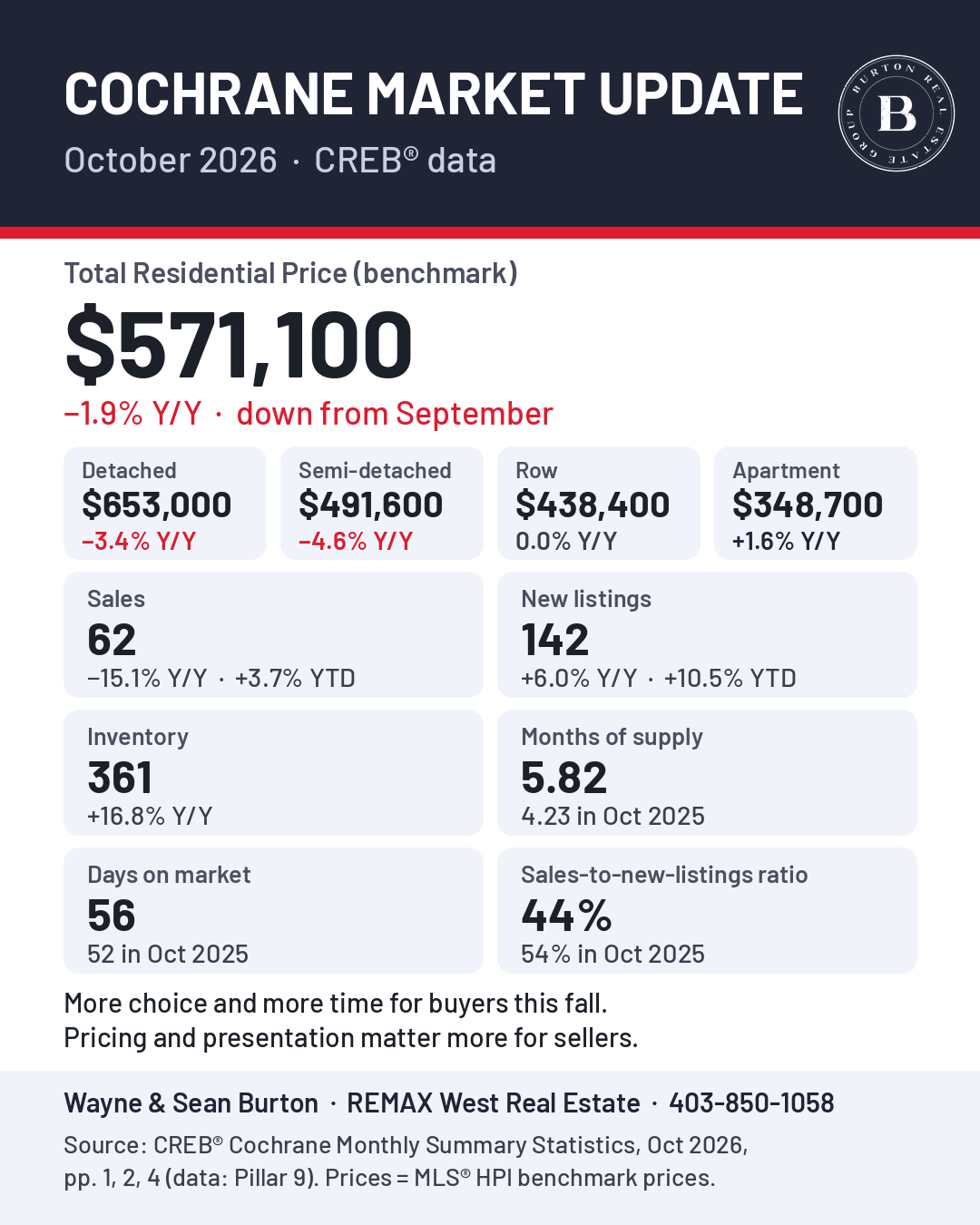
Cochrane market update, October 2026: benchmark price $571,100, 62 sales, 361 homes in inventory, 5.82 months of supply. Source: CREB®.

Prices. Cochrane's Total Residential benchmark price was $571,100 in October, down 1.9% from October 2025 and down from $575,400 in September. By home type:

  • Detached: $653,000 (−3.4% year over year)

  • Semi-detached: $491,600 (−4.6%)

  • Row: $438,400 (unchanged)

  • Apartment: $348,700 (+1.6%)

Sales and listings. There were 62 sales in October, down 15.1% from 73 a year earlier. Year to date, sales are still up 3.7% (871 so far). New listings rose 6.0% to 142, and are up 10.5% year to date.

Supply. Inventory climbed to 361 homes, up 16.8% from 309 last October. Months of supply rose to 5.82, compared with 4.23 a year ago. CREB® noted that Cochrane's months of supply is approaching six for the first time since early 2020, and that inventory rose in October when it usually declines.

Pace. Homes took an average of 56 days to sell, up from 52. The sales-to-new-listings ratio was 44%, down from 54%.

What it means. Buyers in Cochrane have more choice and generally more room to take their time. For sellers, pricing and presentation matter more than they did a year ago, because buyers are comparing more homes.

Calgary: a split market

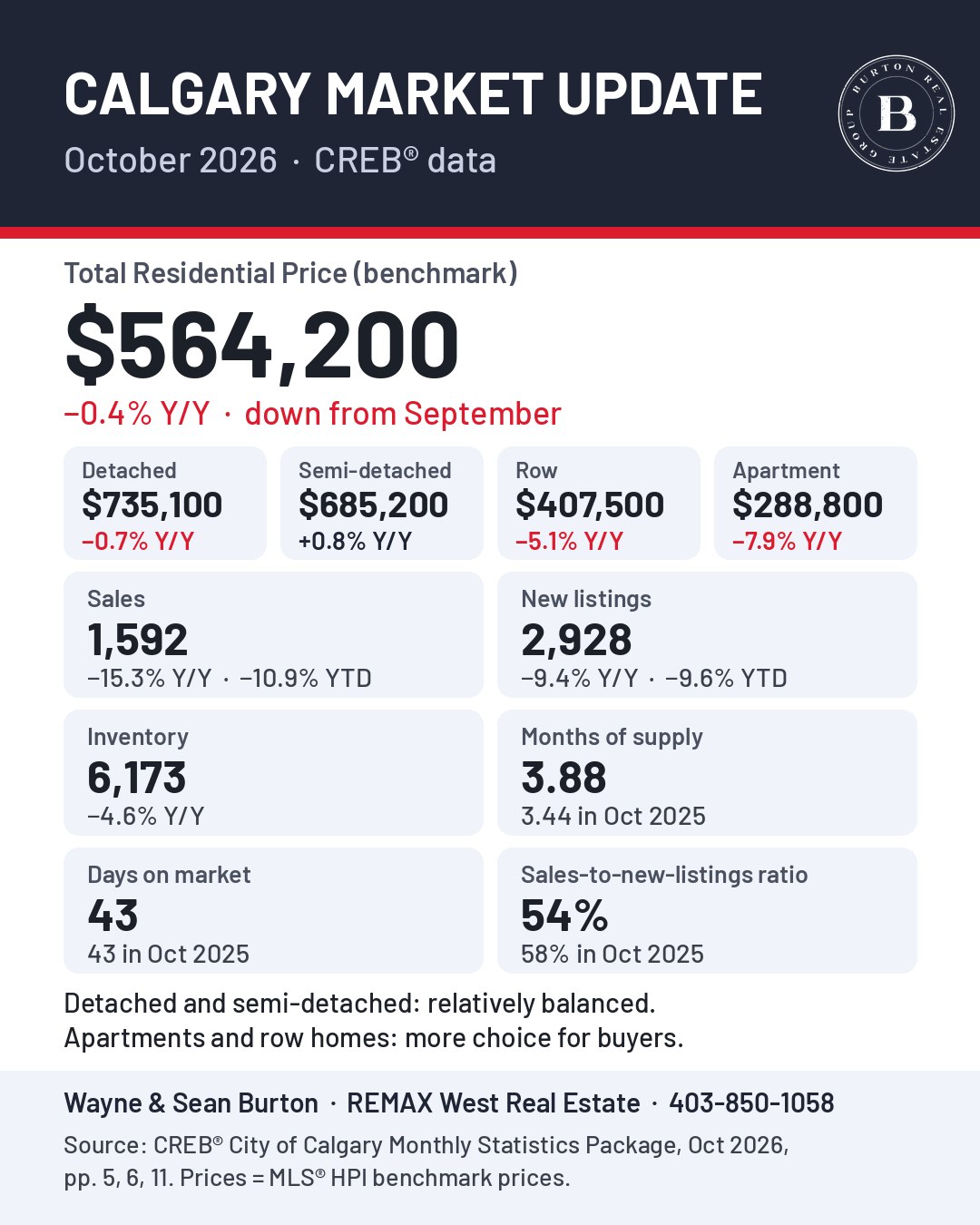
Calgary market update, October 2026: benchmark price $564,200, 1,592 sales, 6,173 homes in inventory, 3.88 months of supply. Source: CREB®.

Prices. The City of Calgary's Total Residential benchmark price was $564,200, down 0.4% from last year and down from $566,700 in September. By home type:

  • Detached: $735,100 (−0.7%)

  • Semi-detached: $685,200 (+0.8%)

  • Row: $407,500 (−5.1%)

  • Apartment: $288,800 (−7.9%)

Sales and listings. Calgary recorded 1,592 sales, down 15.3% year over year, and sales are down 10.9% year to date. New listings fell 9.4% to 2,928.

Supply. Inventory was 6,173, down 4.6% from last October. Months of supply rose to 3.88 from 3.44, because sales slowed faster than inventory.

Pace. Days on market held at 43, the same as last October. The sales-to-new-listings ratio was 54%, down from 58%.

What it means. Calgary isn't moving as one market. Months of supply was 3.34 for detached and 3.16 for semi-detached homes, compared with 4.44 for row homes and 5.28 for apartments. As CREB® Chief Economist Ann-Marie Lurie put it: "Much of the downward pressure on prices is occurring in the oversupplied higher-density segments of the market, while detached and semi-detached prices have remained more stable."

What this means if you're buying or selling in Cochrane

If you're buying, this is a fall with more homes to compare. With more than 360 homes for sale and longer days on market, you may have more time to view homes, do your homework and write a thoughtful offer.

If you're selling, buyers have options, so first impressions count. A realistic price based on recent sales of similar homes nearby, good photos and a well-prepared home matter more now than they did a year ago.

Every street and home type is a little different, and the town-wide numbers don't tell the whole story for any one property.

Let's talk about your home

Wondering where your home, or your next home, fits in this market? We're happy to walk you through the numbers for your street and home type, with no pressure.

Wayne & Sean Burton · REMAX West Real Estate · 403-850-1058 · burtonrealestate.ca

Sources

Prices are MLS® Home Price Index benchmark prices. Year-over-year changes compare October 2026 with October 2025.

Read

Radon Testing in Cochrane Homes: A Former Home Inspector’s Winter Guide

Before I became a REALTOR®, I spent years as a home inspector. I could tell you a lot about a house from a walkthrough: how the roof was aging, whether the furnace had been looked after, where water was finding its way in. Radon was the exception. You can't see it, smell it or taste it, and nothing about a home's age, style or neighbourhood tells you whether it has a problem. The only way to know is to test.

The good news is that testing is simple, and right now is the best time of year to do it.

What radon is

Radon is a radioactive gas that forms naturally when uranium in soil and rock breaks down. Outdoors it disperses harmlessly. Indoors it can build up, entering through cracks in foundations, gaps around pipes, sump pits and floor drains. Health Canada calls radon the number one cause of lung cancer for non-smokers, which is why it's worth taking seriously even though it's easy to forget about.

Any home can have elevated radon: new or old, with or without a basement, in town or on an acreage. Two houses side by side can test very differently.

Why fall and winter are the best time to test

Health Canada recommends a long-term test lasting at least 91 days, or about three months, and says at least 91 days of the test should fall in the heating season. Its measurement guide describes October through April as the ideal window.

The reason is simple. In winter our windows and doors stay closed, and warm air rising through the house creates a slight draw at the foundation (the stack effect) that pulls more soil gas inside. Indoor radon levels are usually highest in the colder months, so a winter test gives you a conservative, realistic read on your yearly average. A test done in summer, with the windows open, risks underestimating it.

Start a test in early November and you'll have your results by spring.

How to test your home

  1. Get a long-term test kit. Long-term detectors are small and easy to use, and you mail them to a lab when the test is done. Health Canada advises against relying on short tests of a few days to decide whether to fix anything, because radon levels swing from day to day.

  2. Pick the right spot. Place the detector in the lowest lived-in level of the home, the area where someone spends a good part of the day, such as a finished basement, rec room or main-floor bedroom. Keep it away from drafts, heat sources, kitchens and bathrooms, and follow the kit's height and placement instructions.

  3. Record the start date and leave it alone. Live normally. You don't need to change how you use the house during the test.

  4. Mail it in after three months or more. Health Canada says results usually arrive within three to six weeks.

What your result means

The Canadian guideline is 200 becquerels per cubic metre (Bq/m³), based on your average annual level.

  • Below 200 Bq/m³: no action is needed under the guideline. Health Canada notes there's no level that's completely risk-free, so the rest is your call.

  • Above 200 Bq/m³: Health Canada recommends lowering it within one year.

  • Well above 200 Bq/m³: act sooner. The higher the number, the faster you should fix it.

What fixing it looks like

High radon is a very solvable problem. The most common fix is a sub-slab depressurization system: a pipe through the basement floor and a small fan that draws radon from beneath the slab and vents it outside. Sealing cracks and openings helps, but usually doesn't solve it on its own. Use a certified radon mitigation professional, and test again afterwards to confirm the level has come down.

Radon and buying or selling a home

Radon comes up more and more in real estate. A few practical notes from both sides of the table:

  • Sellers: a completed long-term test result, plus any mitigation receipts, is useful paperwork to have ready for buyers.

  • Buyers: a long-term test can't be done in the few days before an offer's conditions come off. If you want peace of mind, plan to test once you've moved in, and know that mitigation is a known, manageable fix.

  • Everyone: a short-term test can flag a concern, but Health Canada recommends basing decisions on a test of at least 91 days.

The bottom line

Radon testing is one of the cheapest, easiest things you can do for your home's long-term health, and the coming months are the right time to do it. Set the detector out in November, mark your calendar for February, and you'll know where you stand.

Have a question about radon, or anything else you've noticed in your home? Send us a message. We're happy to help, no strings attached.

Wayne & Sean Burton, REMAX West Real Estate, Cochrane, Alberta

Sources: Health Canada, Radon guideline; Guide for radon measurements in homes; Long-term test instructions; Should I test for radon?

Read

Glenbow: The Ghost Town Near Cochrane That Built the Alberta Legislature

Drive Highway 1A between Cochrane and Calgary and you'll pass a long, quiet stretch of grassland rolling down to the Bow River. Cattle graze there in winter. Hikers and cyclists use the trails in summer. It looks like it's always been empty.

It hasn't. A little over a century ago, more than 180 men worked a sandstone quarry on this land, and a small town grew up around it. The stone they cut is still standing in some of Alberta's most important buildings.

This is the story of Glenbow.

A water stop becomes a quarry town

Glenbow started as a water stop on the Canadian Pacific Railway main line, a place for steam engines to fill up on the way west out of Calgary. Not much more than that.

Then, in 1905, Alberta became a province. A new province needs a legislature, courthouses and schools, and those buildings needed stone. The hills along the Bow had good sandstone close to the railway, and around 1907 a quarry opened at Glenbow.

A real community followed. Single men and the quarry managers lived in workers' quarters near the pit. Married men and their families lived in Glenbow Village nearby. There was a railway station, a school, a general store and a post office. There was even a union labour hall, one of the only public buildings in the settlement.

The stone that built a province

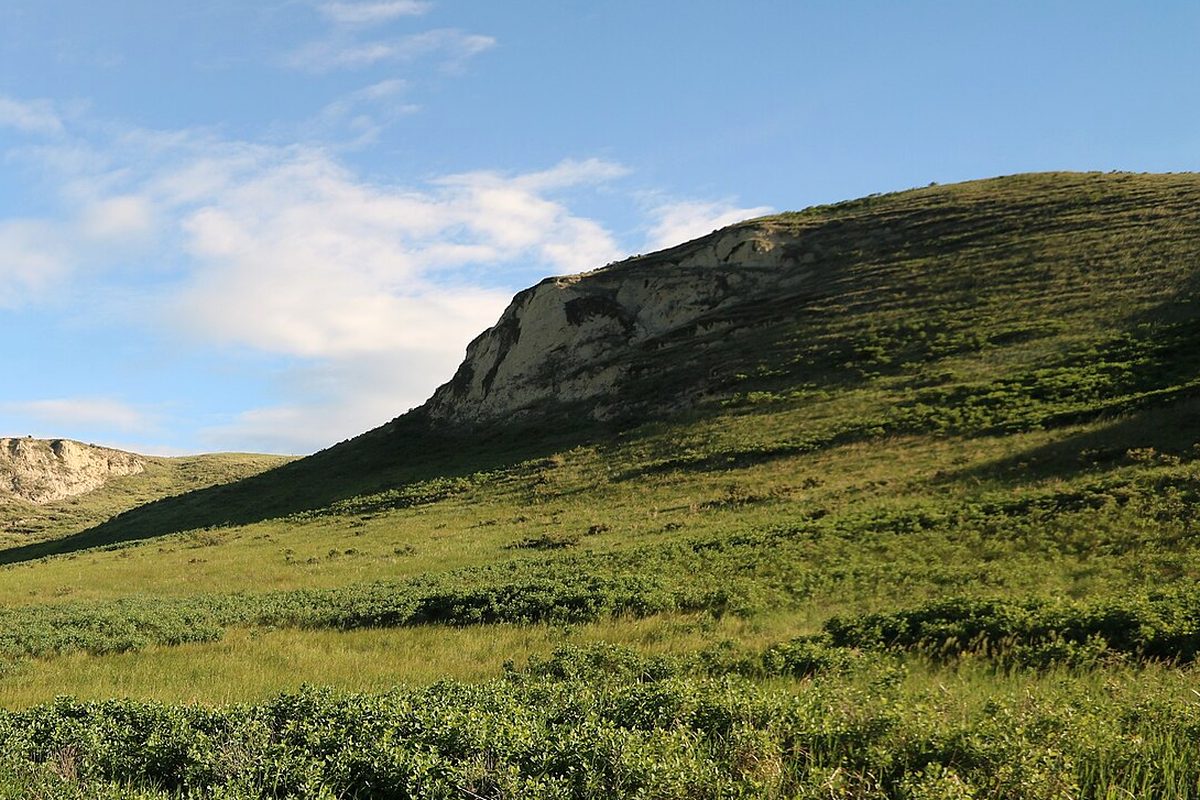
Close view of an exposed sandstone face on a grassy hillside at Glenbow Ranch

Exposed sandstone on the hillside. Photo: davebloggs007 / Flickr, CC BY 2.0.

Glenbow sandstone was cut into blocks and finished decorative pieces. It went into the Alberta Legislature Building and Government House in Edmonton. In Calgary, it went into Courthouse No. 2 and the old Normal School, which is now the McDougall Centre.

So the next time you see a photo of the Legislature, there's a good chance some of that stone came from a hillside between here and Calgary.

The people of Glenbow

What makes Glenbow special is how much we now know about the people who lived there. Since the late 2000s, the Calgary Centre of the Archaeological Society of Alberta has been studying the site. Because the town was so short-lived and the land went back to ranching, a lot was left undisturbed.

In 2017 the team relocated and excavated the cornerstone of the union hall, last photographed in 1973. One of the names carved on it led researcher Shari Peyerl to a stonecutter named Joseph Towill. He had crossed from Scotland hoping to audition for the Metropolitan Opera in New York. He ran out of money, heard there was work in Calgary, and settled here instead. In 1908 he was part of a national championship football team, what we'd call soccer today.

Another name from the records is Ida McCormick, the only woman known to have worked at the quarry, possibly as its accountant or secretary. All told, the research traced 72 families connected to Glenbow.

Why Glenbow emptied out

Glenbow's boom didn't last. Once the big government buildings were finished, demand for sandstone dropped, and the quarry closed in 1912.

The owner, Chester Rhodes de la Vergne, opened a brick plant in the valley to give families another source of work. Then the First World War began, and the brickyard shut down too. People drifted away to the cities or to jobs on nearby ranches. By 1927 the last residents were gone.

The buildings didn't survive either. Some were carted away for lumber, some were moved whole, and some were burned. Today a few foundations, piles of unused bricks and the old quarry workings are most of what's left.

From ranch to provincial park

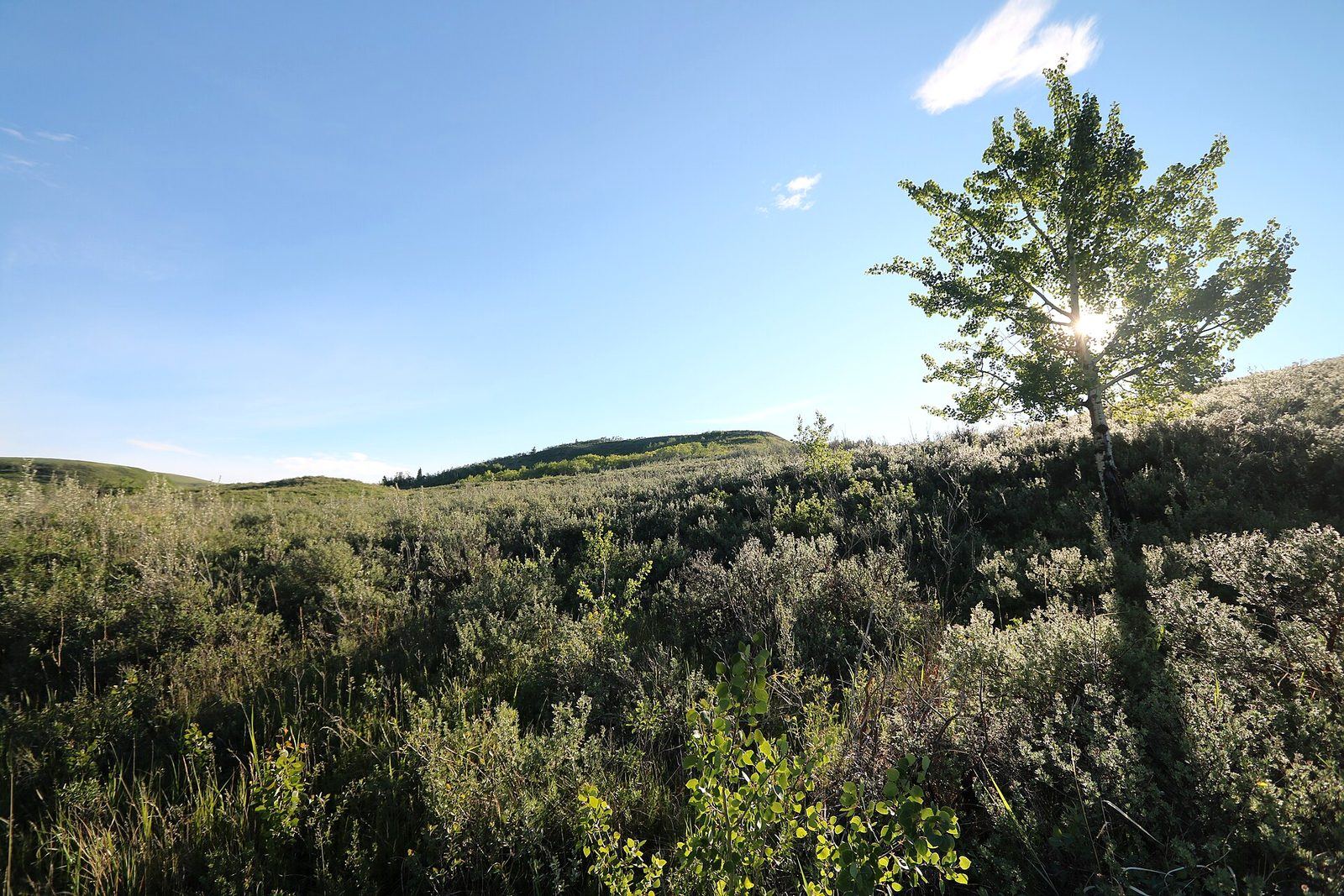
Native grassland and shrubs at Glenbow Ranch Provincial Park, with a single aspen tree backlit by the sun

Today the land is part of Glenbow Ranch Provincial Park. Photo: davebloggs007 / Flickr, CC BY 2.0.

In the 1930s the land became part of a ranch owned by Eric Harvie, and it stayed a working ranch for decades. In 2006 the Harvie family and the Government of Alberta arranged for the land to be preserved, and Glenbow Ranch Provincial Park was officially created in 2008. It opened to the public in 2011.

Today the park has more than 25 kilometres of pathways, with viewpoints over the Bow River and interpretive signs that tell parts of this story. It's still used as winter range for cattle, much like the bison that grazed these hills long before the railway came.

Glenbow today

If you live in Cochrane, you've probably noticed the name around town. Our Glenbow neighbourhood shares it. (If local history is your thing, our earlier post on the Cochrane Ranche tells how a failed ranch gave the town its name.)

Next time you're out on the Glenbow Ranch trails, stop at a viewpoint and picture it: a railway station, a schoolhouse, a store, families on their porches, and the sound of men cutting stone that would end up in the Legislature. A whole town, here for about 20 years, then gone.

Thinking about a move in or around Cochrane? Our neighbourhood guide is a good place to start, and we're always happy to talk it through.

Wayne & Sean Burton, REMAX West Real Estate, Cochrane, Alberta

Sources: Alberta Parks: History of Glenbow Ranch; CBC News: Glenbow ghost town archaeology; Archaeological Society of Alberta: Glenbow Project; Government of Alberta: park opening release; Glenbow Ranch Park Foundation booklet

Read

The Story of the Cochrane Ranche: How a Failed Ranch Gave Cochrane Its Name

In the fall of 1881, about 6,800 head of cattle came up the trail from Montana to a brand-new ranch beside Big Hill Creek, just west of where Cochrane stands today.

Within two winters, most of them were gone.

This is the story of the Cochrane Ranche.

The reconstructed corrals at the Cochrane Ranche Historic Site in the Big Hill Creek valley, west of downtown Cochrane

The corrals at the Cochrane Ranche Historic Site. Photo: davebloggs007 / Flickr, CC BY 2.0.

The Senator, the Superintendent and the Big Hill

The senator. Matthew Henry Cochrane was born in Compton, Lower Canada, in 1823. He made his money in the leather and shoe business, then put it into Hillhurst, his farm in Quebec's Eastern Townships, where his purebred Shorthorn cattle became known on both sides of the Atlantic. He was appointed to the Senate in 1872.

Portrait of Senator Matthew Henry Cochrane, photographed by William James Topley in 1879

Senator Matthew Henry Cochrane, 1879. Photo: William James Topley / Library and Archives Canada (public domain).

The lease. In 1880 and 1881, Cochrane pressed Ottawa for a system of large, long-term grazing leases in the North-West Territories, with single leases of up to 100,000 acres. When the policy came in, the Cochrane Ranche Company, backed by a group of eastern investors, secured the first lease: a sweep of the Bow Valley west of Calgary that sources put at roughly 100,000 to 109,000 acres. More leases around it soon followed.

The superintendent. To run it, the company hired James Walker, who had joined the North-West Mounted Police in 1874 and retired as a superintendent. Decades later, in 1975, Calgary would name him its "Citizen of the Century."

The Big Hill. Walker chose a sheltered spot on the west bank of Big Hill Creek, where the creek valley opens into the Bow Valley, just west of the long ridge known as the Big Hill. Early maps label it Manachaban Hill, though sources differ on what that name means. In the ranch's day the whole operation went by the hill: cattle were contracted for delivery "to Big Hill," and the property was known as the lease on the Big Hill. The town that came later grew up along its southwest slope.

Two Winters on the Big Hill

Fall 1881. I.G. Baker and Company of Fort Benton, Montana, was hired to bring the herd north. To beat the snow, the drovers pushed the cattle 15 to 18 miles a day, with little time to graze. About 6,800 head reached the lease, worn thin from the trail.

Winter 1881–82. Hay had been put up only for the purebred stock. The range cattle were expected to fend for themselves. Winter came early and hard, and roughly 1,000 head died.

There's a story told about that first winter. Before the cattle came, the senator met "Kootenai" Brown, a long-time foothills resident, out on the range. Brown warned him about the winters and told him to put up hay. Cochrane didn't take the advice.

1882. Walker went back to Montana and bought thousands more head. After clashing with the owners, he resigned that year. He took the ranch's small sawmill as part of his settlement and moved it to Calgary.

October 1882. The second herd, 4,290 head, reached the ranch after another hard drive and an early snowstorm. When the trail boss asked to let the cattle rest first, Walker, under orders to get them onto the range, refused.

Winter 1882–83. The new team, bookkeeper Frank White and cattleman W.D. Kerfoot, faced a winter worse than the first. The owners ordered the cattle held on the snow-covered lease instead of letting them drift to open range. Losses topped 3,000 head.

Spring 1883. The commonly cited count is that about 4,000 head were left of some 12,000 that had passed through the ranch, counting calves born on the range and about 2,000 sold as beef to the Mounted Police and nearby reserves. One Parks Canada historian thinks even the loss figures may have been overstated. Either way, the owners had seen enough.

From Ranch to Railway Town

1883: the move south. The company moved its cattle to a new lease between the Belly and Waterton rivers. There, with hay put up for winter and shelters built, the Cochrane Ranche went on to succeed.

1884: the sheep years. Back on the Bow, the owners reorganized the original lease as the British American Ranche Company. They ran horses there first, then brought in about 8,000 sheep in 1884, with Kerfoot in charge.

1885: a townsite. Meanwhile, the Canadian Pacific Railway had built its main line up the Bow Valley, right through the lease. In 1885 a townsite was granted to the railway below the Big Hill, and the CPR named it Cochrane in honour of the senator.

For years, the ranch still surrounded the little townsite, and few people lived there. A rival settlement, Mitford, sprang up a few miles to the west. When Mitford faded in the 1890s, Cochrane became the centre for the farms around it.

1887–88: the end of the lease. Settlers were pressing to open the big leases to homesteads. In 1887 the ranch was split along the Bow River, with the horses moved to the south side. In 1888 about 7,000 sheep and 41,000 acres of the old lease were put up for sale, and much of the land north of the river went to new settlers.

1903 and after. The hamlet of Cochrane became a village in 1903. Around the turn of the century, brickyards operated on the old ranch site itself, and before the First World War the village also had a stone quarry and a sawmill. Cochrane became a town in 1971.

The Men of Vision bronze statue of a cowboy on horseback, on the bluff above the Cochrane Ranche Historic Site

Men of Vision, on the bluff above the historic site. Photo: davebloggs007 / Flickr, CC BY 2.0.

The Cochrane Ranche Today

The old headquarters is now the Cochrane Ranche Historic Site, on Highway 1A just east of Highway 22. The province designated it a historic site in the 1970s. The provincial register dates the designation to March 1976, and the public announcement followed in October 1977.

Archaeologists have excavated the manager's house and the cowboys' bunkhouse, and their footprints are laid out where they stood. A self-guided walking trail follows Big Hill Creek past a reconstructed 1880s-style corral with branding gates.

Up on the bluff stands Men of Vision, a bronze cowboy on horseback by local sculptor Malcolm "Mac" MacKenzie. It was cast in England and unveiled in 1979, and it looks out over the valley where the ranch began.

Walk up to the statue on a clear day and you can see the whole story at once: the creek valley Walker picked, the Bow River beyond it, and the town spreading along the foot of the Big Hill. The ranch lasted only seven years on the Bow. The name it left behind is on every sign into town, and the western character it started is still part of what makes Cochrane feel like home.

If you're new to Cochrane or thinking about a move here, our Cochrane Relocation Guide and Neighbourhood Guide are good next reads.

Wayne & Sean Burton, REMAX West Real Estate
Sources

  1. Alberta Register of Historic Places, "Cochrane Ranche" (Statement of Significance). https://hermis.alberta.ca/ARHP/Details.aspx?DeptID=1&ObjectID=4665-0153

  2. Alberta Register of Historic Places, heritage survey file HS 73348, "Cochrane Ranch Co. Ltd." (timeline and October 1977 designation release). https://hermis.alberta.ca/ARHP/Details.aspx?DeptID=2&ObjectID=HS+73348

  3. Roderick J. Heitzmann, The Cochrane Ranche Site, Archaeological Survey of Alberta Occasional Paper No. 16 (Alberta Culture, 1980), as excerpted by Library and Archives Canada. https://epe.lac-bac.gc.ca/100/205/301/ic/cdc/pasttopresent/rural_life/cochrane_ranche_history.html

  4. William Naftel, "The Cochrane Ranch," Canadian Historic Sites: Occasional Papers in Archaeology and History No. 16 (Parks Canada). http://parkscanadahistory.com/series/chs/16/chs16-4h.htm and http://parkscanadahistory.com/series/chs/16/chs16-4i.htm

  5. Dictionary of Canadian Biography, "Cochrane, Matthew Henry." https://www.biographi.ca/en/bio/cochrane_matthew_henry_13E.html

  6. Dictionary of Canadian Biography, "Walker, James." https://www.biographi.ca/en/bio/walker_james_16E.html

  7. The Canadian Encyclopedia: "Cochrane Ranche," "Cochrane (Alta)," "Matthew Henry Cochrane" and "James Walker." https://thecanadianencyclopedia.ca/en/article/cochrane-ranche

  8. Town of Cochrane, "History of Cochrane," "Cochrane Ranche Historic Site" and "Men of Vision Statue." https://www.cochrane.ca/community-culture/history-cochrane

  9. Cochrane Historical & Archival Preservation Society (CHAPS), "Place Names of Big Hill Country," "Cochrane" and "Village of Cochrane 1903." https://chapscochrane.com/place-names-complete-listing/

  10. Donald Edward Brown, A History of the Cochrane Area (MA thesis, University of Alberta, 1951). https://archive.org/details/historyofcochran00dona

  11. Alberta Cattle Feeders' Association, From Start to Finish: An Illustrated History of Cattle Feeding in Alberta. https://www.cattlefeeders.ca/wp-content/uploads/2016/01/From-Start-to-Finish-Cattle-Feeding-History.pdf

  12. Cochrane Tourism, "Cochrane Ranche Walking Trail." https://cochranetourism.ca/blog/scavenger-hunt-at-cochrane-ranche/

  13. Cochrane Eagle, "Men of Vision celebrating 35th." https://www.cochraneeagle.ca/local-news/men-of-vision-celebrating-35th-1448524

Photo credits: Corrals and Men of Vision photos by davebloggs007 on Flickr, CC BY 2.0, via Wikimedia Commons. Portrait of Senator Cochrane by William James Topley, 1879, Library and Archives Canada, public domain.

Read

A Home Inspector’s Fall and Winter Prep Checklist for Cochrane Homes

Before I became a REALTOR®, I spent years as a home inspector. One pattern stood out: the costly repairs usually started as small, cheap ones that nobody got to before winter. Cochrane's weather can swing from a mild chinook afternoon to a hard freeze overnight, and that is tough on a house.

The good news is that most of this list is a weekend job with basic tools. Here's what I check on my own home every fall, and how to do each step.

1. Change the furnace filter and book a service

Your furnace works hardest from October to April. A clogged filter makes it run longer and work harder.

  • Find the filter. It's usually in a slot between the return air duct and the furnace. Check the size printed on the frame before you buy a new one.

  • Install it the right way. The arrow on the frame points toward the furnace, in the direction the air flows.

  • Check it again. Look at it monthly through the winter and follow the manufacturer's replacement schedule. Homes with pets or renovation dust may need changes more often.

  • Book a service. If it's been more than a year since a qualified technician looked at your furnace, book one now, before the busy season.

While you're there, make sure nothing is stored against the furnace or the hot water tank. Both need clear space around them.

2. Clean the eavestroughs and check your downspouts

Leaves and grit in the eavestroughs make water spill over the edge and pool beside the foundation. In winter, the same blockage can lead to ice building up along the roof edge.

  • Clean them out. Once most of the leaves have fallen, scoop out the debris from a stable ladder, or have someone do it for you. Always have a second person nearby.

  • Flush them with a hose. Confirm the water runs freely to each downspout.

  • Extend the downspouts. Make sure each one discharges at least 1–2 m away from the foundation, using extensions or splash pads.

  • Check the grading. Look at the soil around the house. It should slope away from the walls, not toward them.

3. Shut off and drain outdoor taps

A hose left connected can trap water in the tap, and when that water freezes, the pipe can split inside the wall. You often won't know until spring.

  • Disconnect every hose. Drain them and store them.

  • Close the shut-off valves. If your outdoor taps have an indoor valve, usually in the basement near the exterior wall, close it. Then open the outside tap to let the remaining water drain out.

  • Know your tap type. Many newer homes have frost-free taps. Even so, they still need the hose removed to work as designed.

  • Check your irrigation system. If you have one, have it blown out before the first hard freeze.

4. Check the attic hatch and look for frost or damp spots

Warm, moist air escaping into a cold attic can condense or frost on the underside of the roof sheathing.

  • Check the hatch. Make sure the attic hatch has weatherstripping and closes snugly. Add a strip of foam weatherstripping if it doesn't.

  • Look around with a flashlight. On a cold day, peek into the attic, being careful to step only on framing. Look for frost, dark staining, or damp insulation.

  • Check the vents. Make sure the bathroom and kitchen fans vent to the outside, not into the attic, and that the insulation isn't blocking the soffit vents.

5. Test smoke and carbon monoxide detectors

Heating season is when CO alarms matter most.

  • Test every alarm. Press the test button on each one.

  • Replace the batteries. Do it in any battery-powered units.

  • Check the dates. Detectors have a manufacture date and an expiry date printed on them. Replace any that are past the manufacturer's recommended life.

  • Check your coverage. Make sure there's a working CO alarm near the sleeping areas and on any level with a fuel-burning appliance.

6. Re-caulk drafty windows and doors

Drafts make a home less comfortable and waste heat.

  • Find the drafts. On a windy day, run the back of your hand around window and door frames to feel for moving air.

  • Re-caulk the outside. Scrape out cracked or shrunken caulking and apply new exterior-grade caulk. Do this on a dry day, above the temperature listed on the tube.

  • Replace worn weatherstripping. Check exterior doors and the door from the garage into the house. Adjust the door sweep so it seals against the threshold.

When to call a pro

Some jobs are better left to a licensed professional:

  • Any furnace service, gas smell, or appliance that won't stay lit (if you smell gas, leave the house and call your gas provider)

  • Roof work, or eavestroughs you can't reach safely from a ladder

  • A water stain that keeps growing, or a musty smell in the attic or basement

  • Electrical issues such as warm outlets, flickering lights, or a breaker that keeps tripping

  • Cracks in the foundation that let in water

A little time now saves a lot later

None of this needs to happen in one day. Pick a dry weekend, work through the list, and make notes of anything you want a professional to look at. If you're planning to sell in the next year, this list also doubles as a head start on the things a buyer's inspector will look at.

If you notice something in your home and aren't sure whether it's a big deal, send us a message. I'm happy to share what I'd look for, no strings attached.

Wayne & Sean Burton, REMAX West Real Estate, 403-850-1058, info@burtonrealestate.ca

Read

Easier way‘s to stay show-ready

Selling a family home while still living in it isn’t about chasing spotless perfection every day, it's about setting up an easy daily rhythm that keeps chaos in check and makes showings feel less like emergencies. 🏡✨

A daily reset works because it means the main living spaces get a quick touch-up, beds made, counters wiped, dishes loaded, and toys or pet gear tucked away before heading out. Fast-clear bins and hidden storage keep clutter manageable, while simple, age-appropriate chores give everyone a role. This routine handles not only the mess but also the moving parts, prepping a go-to plan for pets and kids, locking up valuables, and making sure the yard looks inviting no matter the season. Calgary homes see everything from muddy entrances to backyard pet evidence, so a reliable reset makes a difference in both first impressions and stress levels.

Keeping things just one step from showing-ready turns last-minute requests into something your family can handle, no panic required. If you're getting your home ready for the Calgary market and want guidance on making these daily resets easier, reach out for support that puts your family’s routines first. 😊

Read

A pre-approval letter changes how your offer lands with sellers.

Getting rejected as a buyer isn’t just about your offer price, it’s about whether you’re prepared before you even write that offer. 💡 In Calgary, sellers and their agents can spot unprepared buyers instantly. If you’re not pre-approved, your offer often doesn’t make it past the first round.

Pre-approval isn’t just a box to check; it’s proof to sellers that you have the financial backing to close, and that you’re serious in a market where homes can draw multiple offers overnight. Offers backed by actual pre-approval are seen as stronger and safer because sellers know they’re less likely to fall apart at the last minute. Skipping this step or confusing pre-qualification with real pre-approval signals you’re not ready, and in a fast-moving Calgary market, that gets your offer sidelined quickly. ⚡

Many buyers delay because they worry about their credit score or think they have time to get approved after finding a home. But hesitation leaves you scrambling when a listing appears, while pre-approved buyers move forward confidently and secure the best opportunities. In today’s market, being proactive with pre-approval is no longer optional, it's a non-negotiable for anyone who wants to compete.

Thinking of making a move? Getting pre-approved early saves you stress, gives your offer real power, and puts you in the best position when the right home hits the market. Let’s connect to get you fully prepared for success in Calgary’s market! 🏡✨

Read

Calgary's condo market favours buyers now.

Buyers looking for a foothold in Calgary’s market are finally getting a break in the condo sector. 🏙️

With more listings and gentler pricing pressure, apartment-style condos now offer much-needed breathing room compared to the intense pace of detached homes. This shift is especially welcome for first-time buyers, upsizers exploring affordability, and those looking for practical options to match new lifestyles. In many cases, increased inventory means you’ll see more properties, less competition, and room for negotiation, qualities that can make a real difference when the process feels overwhelming.

If you’re considering your next step in Calgary, it’s a great moment to explore the attached market, especially condos, where buyer-friendly conditions can help you secure a space that fits your needs and budget. Curious about what these changes mean for your search? Reach out to explore your options and navigate this evolving market with confidence. 💬✨

Read
Data is supplied by Pillar 9™ MLS® System. Pillar 9™ is the owner of the copyright in its MLS®System. Data is deemed reliable but is not guaranteed accurate by Pillar 9™.
The trademarks MLS®, Multiple Listing Service® and the associated logos are owned by The Canadian Real Estate Association (CREA) and identify the quality of services provided by real estate professionals who are members of CREA. Used under license.